What this page covers
Two jobs: nail pops and small holes (fist-size or smaller). Both take basic tools, a free afternoon, and patience with sanding. Anything bigger, wet, or cracked — that is our work, and we will tell you why below.
What you need
- Lightweight spackle or joint compound
- Putty knife (4-inch) and a wider taping knife (8-inch)
- Fine sandpaper or sanding sponge (120–150 grit)
- Hammer and nail set (for nail pops)
- Self-adhesive mesh patch (for holes bigger than a nail head)
- Primer and matching paint
Fixing nail pops
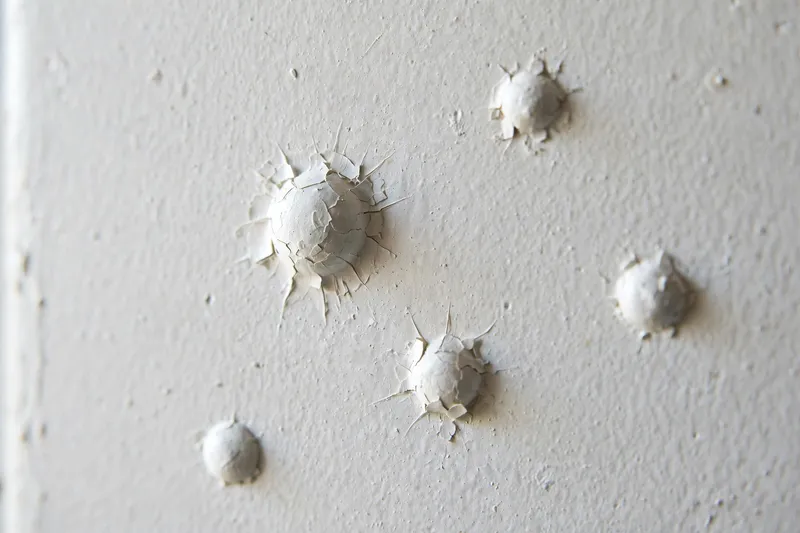
- Reset the nail. Put the nail set on the popped nail head and tap it just below the surface with the hammer. Do not smash the drywall paper.
- Add a screw. Drive a drywall screw about an inch above or below the old nail so the board is held tight to the stud. This is the step most DIY guides skip — it is why pops come back.
- Fill. Two thin coats of compound beat one thick coat. Let each coat dry fully.
- Sand, prime, paint. Sand smooth, spot-prime (compound drinks paint unevenly), then paint. Feather the paint edges so the patch disappears.
Fixing small holes
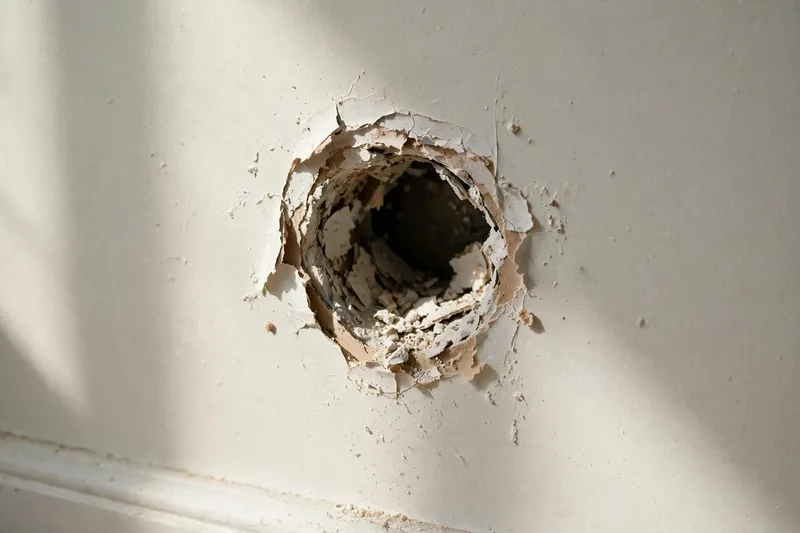
- Trim the damage. Cut away loose paper and crumbly gypsum so the patch has solid edges.
- Patch it. Holes under an inch: fill with spackle in thin layers. Holes up to fist-size: stick on a self-adhesive mesh patch first, then compound over it.
- Feather wide. Spread each coat wider than the last — a 4-inch hole wants compound feathered out 10–12 inches. Narrow patches show.
- Sand, prime, paint. Same finish routine as nail pops. Match the wall texture as best you can while the compound is workable.
Stop and call us when
- The hole is bigger than your fist — big patches need backing and wide feathering to vanish.
- There is any water staining or softness — moisture damage is never just cosmetic.
- Cracks keep coming back after you patch them — something is moving and needs diagnosis.
- The damage is on a ceiling — overhead mud work is miserable and gravity always wins against beginners.
- You need texture to match — orange peel and knockdown take practice to blend invisibly.
No shame in any of these. The most expensive drywall job is the one you do twice — once yourself, once by us fixing it.
Get your free estimate
Call (240) 213-2890 or send the form. We come look, measure, and give you a written price — free, no pressure.